Madrid is a wonderful city and remarkably safe for a metropolis its size. It’s the perfect escape for solo female travelers over 50, filled with art, great food, fabulous architecture and an energy that lasts far beyond sunset. Here’s what you can do if you only have one day in Madrid.
This itinerary highlights the kinds of things you can do in the Spanish capital if you only have a single day. In other words, don’t think you can’t see plenty just because your time is limited.
That said, you’ll see a lot more if you stay a bit longer…
Why is Madrid a good fit for solo female travelers?
Madrid is a city where we can lose ourselves in a relatively small, walkable area, which means you’ll be able to see a lot in little time. Your problem will be what to choose (especially if you’re planning a short Madrid one-day itinerary).
People are pleasant and helpful, and there’s no stigma whatsoever attached to being on your own, not even if you walk into a bar, but more on that later.
It’s simply a delightful city at every level, art of course, but also history and food, which are just a few of the things I look for in a city.
How safe is Madrid?
Traveling to Spain alone is perfectly feasible – you’ll face no greater danger than traveling in most other European countries, with one exception – Madrid, like Paris, has seen several terrorist attacks. Both the UK and the US governments suggest you be extra cautious and be watchful while you’re there. In other words, be attentive in crowded places and don’t hesitate to walk away if something feels wrong. But as far as I’m concerned, Spain is one of the best places to travel alone female. Solo travel in Spain, even a quick 24 hours in Madrid, remains an excellent choice for women.
That said, your eyes should always be open, precisely because there are many tourists. Crowds mean pickpockets and plenty of petty thieves – the kind who will grab your bag from a chair and run, or who will zip by on a scooter to tear it off your shoulder. These things happen, and solo travel in Spain means being watchful. (Pickpockets are less frequent in Madrid than in Barcelona, where theft is more visible.)
Spain has always had a bit of a “macho” vibe although things have toned down significantly in recent years. If someone says something to you on the street, ignore it and walk off. There’s virtually no chance someone will actually be trying to make conversation with you so it’s safe to assume it’s a come-on. Walk away. Violence is extremely rare so your risks of upsetting someone are minimal.
A word about nighttime in Madrid: some areas will probably be crowded, even at 2 am. But do yourself a favor and unless your hotel happens to be in the very heart of the action and you’re a few feet away, take a taxi. They’re plentiful, inexpensive, and safer than walking down a side street on your own (especially for those only visiting Madrid in a day who may be unfamiliar with local neighborhoods).
Your biggest safety challenges: holding on to your belongings. In public, make sure you have an anti-theft bag of sorts – this one is hugely popular. Also, take precautions in your hotel room to keep any potential thieves at bay. Just be aware, but don’t obsess about this. Leave your valuables at home, make copies of your important papers, and enjoy the city!
For emergencies, use the European emergency number, 112. Madrid also has a Tourist Police called SATE, with offices at Calle de Leganitos 19.
Where to stay in Madrid
Choose your neighborhood wisely, partly for safety’s sake, and partly for noise – Madrid nightlight can get loud and seems to go on forever. For example, Malasaña is perfectly safe, but it’s filled with funky bars and restaurants, and the noise levels can be excessive late into the evening.
There are plenty of great neighborhoods to stay in in Madrid, but since we’re talking about a single night, only two stand out: the downtown core or the airport. If you’re flying out in the early morning, by all means, stay near the airport, and any hotel near the airport will do (see a selection of Madrid airport hotels here). But if not, treat yourself: downtown is the best place to stay in Madrid with great options for all budgets.
Centro: this means downtown, and it’s where some of the major museums are located, along with the best shopping along well-lit avenues.
Salamanca: this is an exclusive part of town, and among the most expensive – and safest.
Chamberí: this is also very safe, and great for families.
In the luxury range, recommended hotels include the Hotel Urban Madrid for pure style (Papuan Art Deco, anyone?) and the Hotel Wellington, for sheer history and elegance. There’s also the Ritz, a longtime Madrid landmark that has been here for generations.
In the good value mid-range, try the Hostal Oriente, near the Opera metro station or the Carlton Hotel, not far from Madrid’s magnificent museums.
Finally, in the rock-bottom hostel range, The Hat is near the Plaza Mayor and Old Madrid, a bit more upmarket than your regular dorm, or if you’d rather be in the heart of Chueca, Madrid’s gay neighborhood (and stuffed with tapas bars) the 007 Chueca will put you in the center of the action.
For more choices, check out the map below:
6 Foods you must try in Madrid
Before we go any further, let’s talk about food for a moment, because as you’ll see below, almost every street and plaza leads you to food.
The great thing about eating out in Madrid is that you can easily do it on your own, so if you’re traveling solo, you’ll feel perfectly at ease. Hopping around from bar to bar eating tapas is something you can do without any company whatsoever – look around and you’ll see plenty of other solo travelers.
Here are some favorite tapas to eat in Madrid:
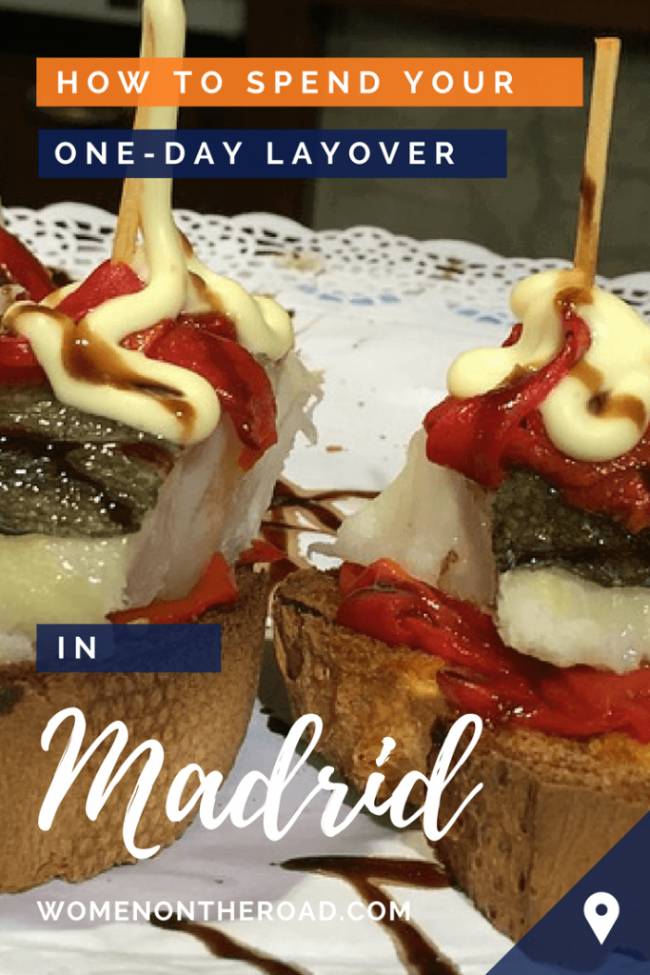
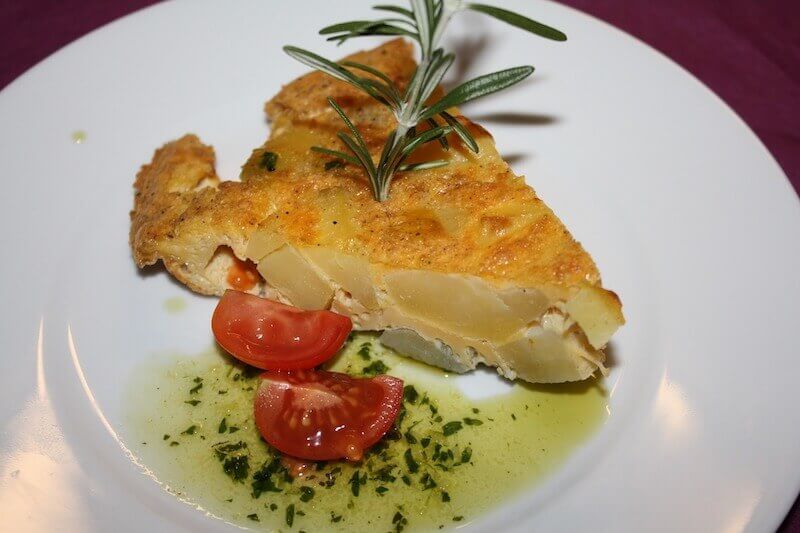
- tortilla española, or Spanish omelet, made with potato and usually onions (although there’s an entire school of thought that believes onions are sacrilegious) – just make sure the tortilla is homemade (just ask, es casera?)
- croquetas, deep-fried croquettes made with ham, chicken, cod, or tuna
- ensaladilla rusa, which means Russian salad for some obscure reason: it’s a mayonnaise-based potato salad with a few diced vegetables, hard-boiled egg, and tuna (divine if it’s made properly, and downright awful if not)
- boquerones, or anchovy fillets in brine or vinegar (try at least one, even if anchovies aren’t usually a favorite)
- jamón, Spanish ham of course
- and finally, patatas bravas (potatoes again), in a spicy garlicky tomato sauce.
There are probably as many tapas as there are bars in Madrid, maybe more. But these are among the most typical and best-loved, the ones you’ll find pretty much everywhere because they are so traditional. Try each one and compare!
If you don’t have the time or the energy to suss out the best tapas – especially if you only have 1 day in Madrid – consider a food tour in Madrid to experience a variety in a few hours.
The popular tours run by Devour, such as this half-day ultimate food tour with 12 tastings, uncover everything Madrid has to offer, food-wise. Another good choice is the Tapas, Taverns and History tour for an all-round experience.
If you’re able to spend an evening in Madrid, you can combine tapas and flamenco, and learn all about Spain’s classic dances while sampling the cuisine.
10 Things you must see or do in Madrid
You won’t see all of Madrid in a day, of course, but you can see the high points which – fortunately for visitors – happen to be quite close to one another.
Whenever traveling between Europe and Latin America, it’s worth aiming for a layover in Madrid that can last anywhere from 6-36 hours – because the city rewards even the briefest visit.
If you’re not on a layover, Madrid is easily accessible across Europe and you might consider a 24-hour day trip to Madrid. Challenging, but it CAN be done!
And if you’re on the fence between Madrid or Barcelona…
Allow this itinerary to convince you.
The city center: 24 hours in Madrid
The beauty of this central part of the city is its walkability, with most major sights within reach.
But let’s be realistic. This Madrid one-day itinerary is extremely packed! You can easily eliminate parts of it and focus on others.
The Retiro park, for example, can be scratched off the list in favor of time in a museum. Or you could hang around Old Madrid all day.
The choice is yours.
This Madrid itinerary IS doable in a day – but you’ll need determination if you want to see it all (not to mention a great pair of walking shoes). It’s not exactly the ideal type of travel but we’re not always mistresses of our time, but sometimes seeing Madrid in a day is all the time we have.
The following ten are the sights in Madrid you should not miss. They are also the only ones you’ll have time for if you’re staying for one day in Madrid, Spain.
Just beware – this is a Madrid walking itinerary – in addition to your good shoes, you’ll need an early start and plenty of stamina. If you have none of those, just pick a spot or two, and enjoy. You can easily spend several hours at any of the points on the map.
Also know that spending only a day in town means your museum time will be severely limited. You can nip in for an hour but don’t expect to spend half a day in admiration of Murillo or Velazquez or Picasso – you’ll have to add a day or come back for that.
So – let’s go for your one day in Madrid recommended itinerary by following this One Day in Madrid map!
1. Puerta del Sol
This large square is the throbbing heart of Madrid. On New Year’s Eve, crowds gather here to eat 12 grapes – one for each ringing of the bell – and celebrate.
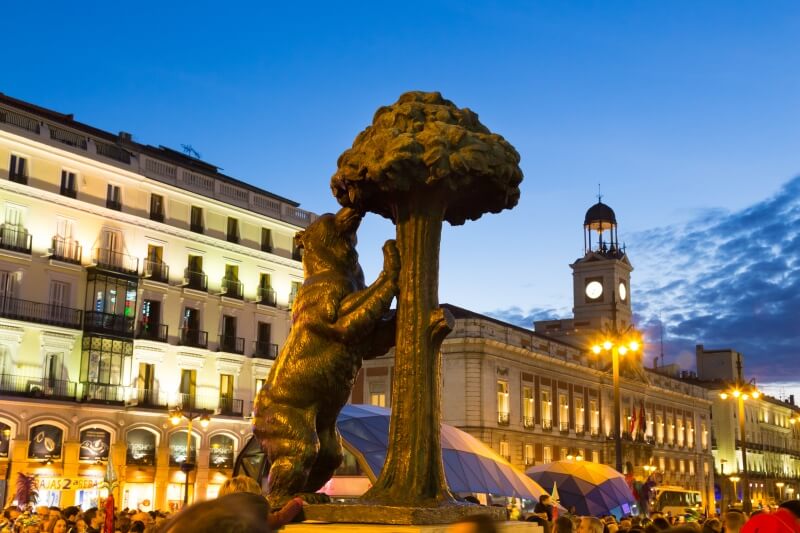
Look on the ground for Kilometer Zero, the start of every major road in Spain, and for the Bear and Strawberry Tree statue, Madrid’s coat of arms. Whenever there’s a march or demonstration in Madrid, this is where it starts or ends.
Lining the south of the square is the post office, which also houses Madrid’s regional government – and once held one of the city’s more notorious prisons in its cellars.
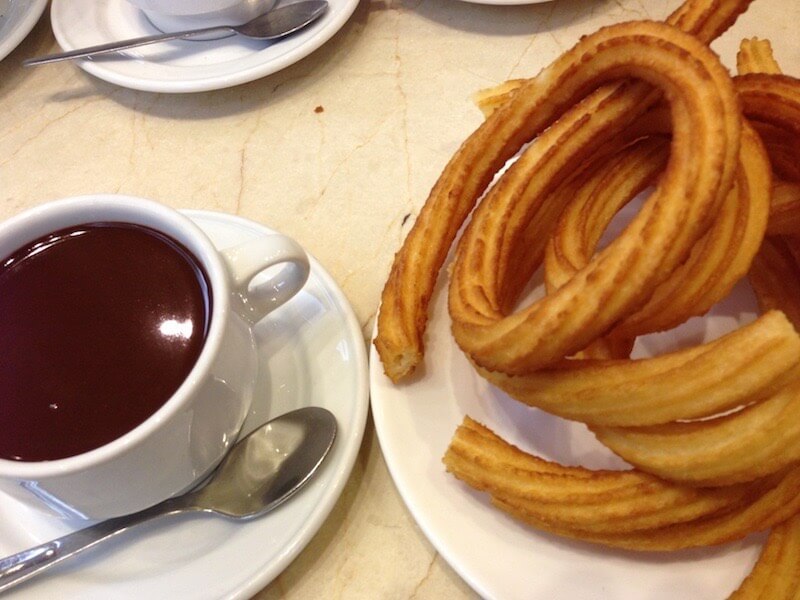
Once you leave the Puerta del Sol – early in the morning ideally – head for Madrid’s favorite breakfast: chocolate con churros. Churros are long, ridged donut-ey pieces that are crunchy on the outside and lightly powdered with sugar. You’ll get anywhere from 3-6 in a portion – pick one up and dip it into the kind of hot chocolate you’ll find only in Spain, so thick you can stand your churro in it. Repeat until plate is empty or stomach full.
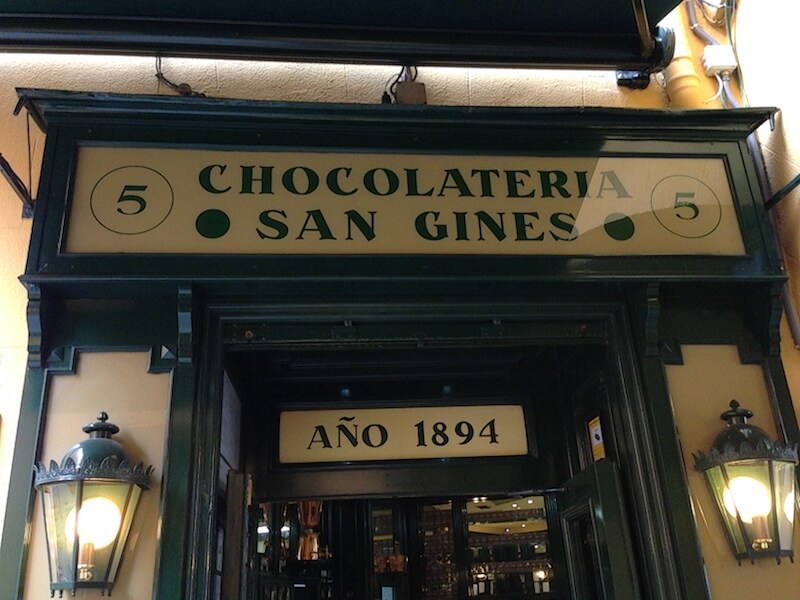
The legendary Chocolatería San Ginés is nearby. It used to be open 24/7 but that’s now only from Thursday to Sunday or the eve of major holidays. From Monday to Wednesday, you can go between 8am and midnight.
Just step up to the cash register, place your order and pay. Your churros will magically appear at your table.
2. Teatro Real and Palacio Real
An opera at the Teatro Real (El Real) is pretty much the only thing that could keep anyone away from an evening of flamenco in Madrid. But check to see what’s playing when you’re making your plans. Ballet, classical music, any and all cultural events center on this magnificent theater.
Madrid wasn’t always called Madrid, by the way. Its original name was Magerid, “rich in water”, not surprising given its location between mountain and river. It’s not a particularly old city and is first mentioned in 865 CE when the emir Muhammed I built a palace there.
Not much is left of this period and transformation into the city we know today began in 1701, with the arrival of Philip V, the first Bourbon king. He was shocked by the city’s insularity and darkness and set out to overhaul it, building fountains, gardens and the new Royal Palace, not to mention a series of the city’s most magnificent churches.
This architectural bonanza opened the way for the Madrid we know and love today (and if you happen to be a history buff, here’s a great overview of the Medieval, Habsburg, Bourbon, and modern periods.)
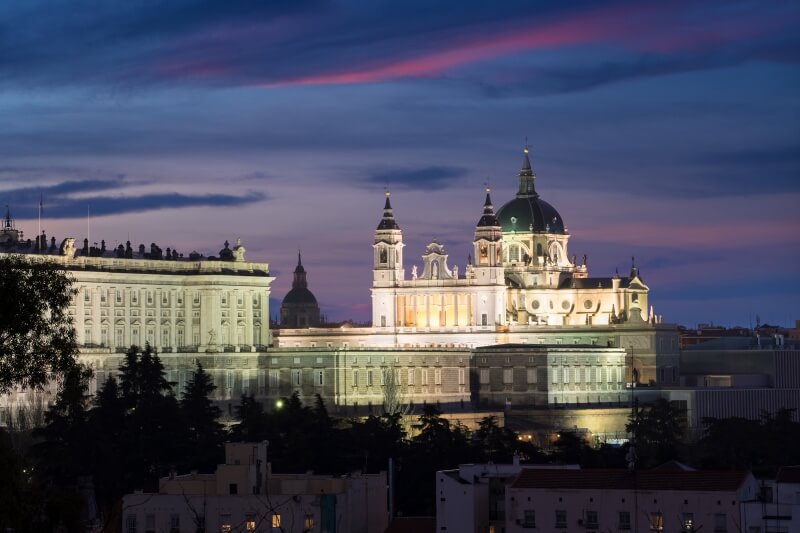
The Royal Palace is the largest royal palace in Europe, built in the mid-18th century on the site of an earlier palace, damaged by fire. You can take a guided tour or make a reservation before you go (the tour is about 1.5 hours).
But beware that spending time here may mean not spending it somewhere else, so weigh your decision. The Palace is often used for official functions so make sure it’s open on that day.
By the time you finish at the palace – if you decide you can squeeze it in – it should be nearing noon and, even after a hearty breakfast, you’ll probably be ready to eat again. Having satiated yourself with culture and history, another nibble awaits.
3. Mercado de San Miguel
This is by far one of Madrid’s favorite food markets, although not everyone agrees. It has plenty of tapas, but you’ll find better ones in the crooked streets of Old Madrid. Still, if you come here, it’s for one thing and one thing only: jamón, or Spanish ham. So if you’re a vegetarian or don’t eat pork, don’t read the rest of this section and jump straight to the Plaza Mayor. Or go to the market, lower your eyes as you walk past the ham stall, and head for the back.
On a recent visit to the Mercado, there was nothing moderate about the mad dash through culinary temptation – seafood, ham, potatoes, skewers, pastries, and those lovely little deep-fried croquettes that are almost addictive.
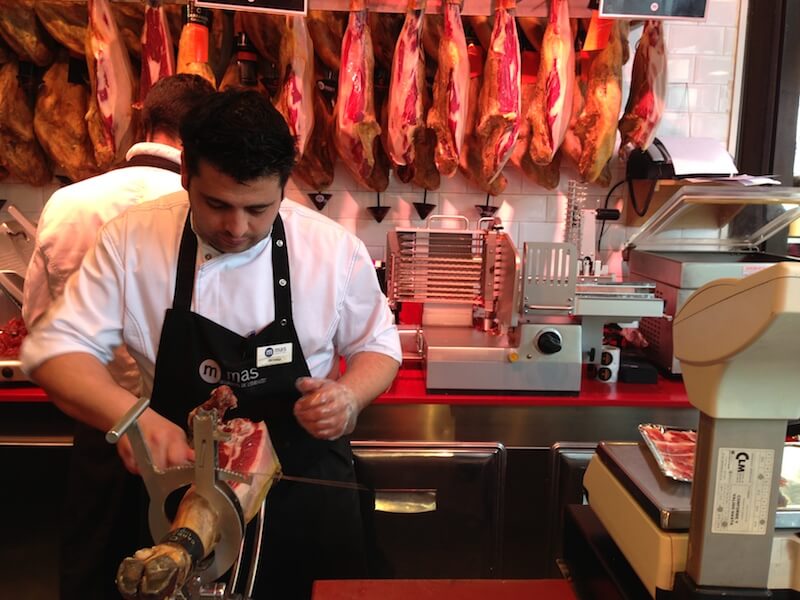
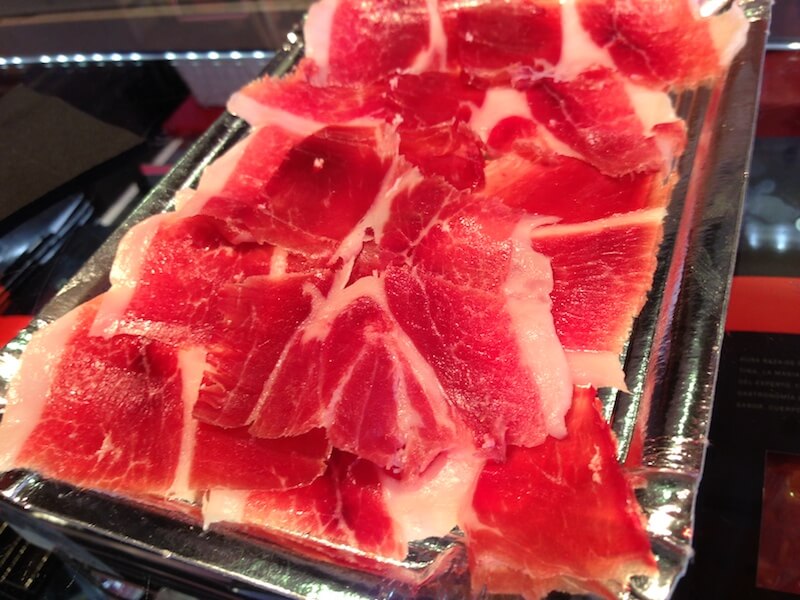
Near the market’s entrance on your right is a row of hams – you can’t miss them. Grab 100 grams of jamón ibérico, stand at the window, and get ready for culinary heaven. Don’t expect anything thick or pink. This ham is a deep burgundy, streaked with fat, and chewier than its cooked counterpart.
Most people familiar with Spanish ham may know the jamón serrano, delicious but not comparable to the jamón ibérico. Curious about the differences? This article explains it all. Your wallet may feel significantly lighter after your snack, but it’s worth every euro.
Another ham-munching destination (and just oozing with photogenic walls) is the Museo del Jamón (Museum of Ham), on the way to the Plaza Mayor. But by now you may be all hammed out… and in any event, you’re heading for tapas and lunch (yes, more eating).
4. Plaza Mayor
Madrid’s ancient center is so compact you’ll barely finish seeing one thing before you’ve reached the next.
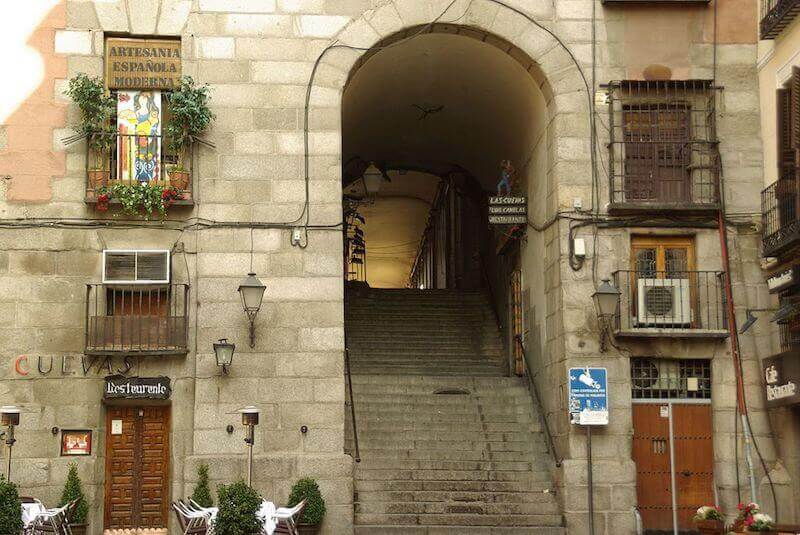
But rather than head into the Plaza Mayor through the most frequented entrance on the Calle Mayor, detour down the Calle Cava de San Miguel and enter the massive square through the Arco de Cuchilleros: go up the steps and through the archway, one of the most photogenic approaches.
Warning: if steps are an issue, use the usual entrance on Calle Mayor – it’s relatively flat.
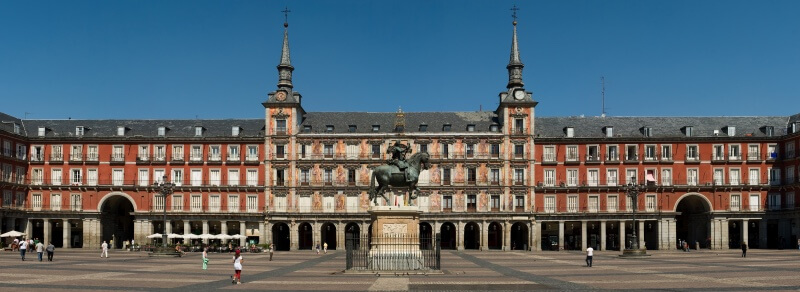
There’s always something happening on the Plaza Mayor. Families stroll, entertainers amuse children and adults alike, and traders exchange stamps and collectibles under the arcades.
The gigantic 17th-century Plaza Mayor has been used for everything from football to bullfighting to executions of heretics during the Inquisition. It was destroyed by fire three times before its present incarnation.
Nowadays, the Plaza is ringed by bars, cafés, and restaurants. Some cater to tourists, but gems remain, like the Casa Botín just outside the walls, often called the oldest restaurant in the world.
Look for the frescoes on the Casa de la Panadería, refreshed but still delightful.
For more authentic tapas, wander out through the same arch and explore nearby streets: try Taberna del Chato on Calle de la Cruz or Casa Labra near Puerta del Sol.
5. El Prado, Reina Sofia Museum or Thyssen museum
By now you’re full (again) and ready for some early afternoon art.
Known as the Golden Triangle of Art, there are three amazing art museums within walking distance of one another but in a single day, you won’t make it to all three, so choose one depending on your interests.
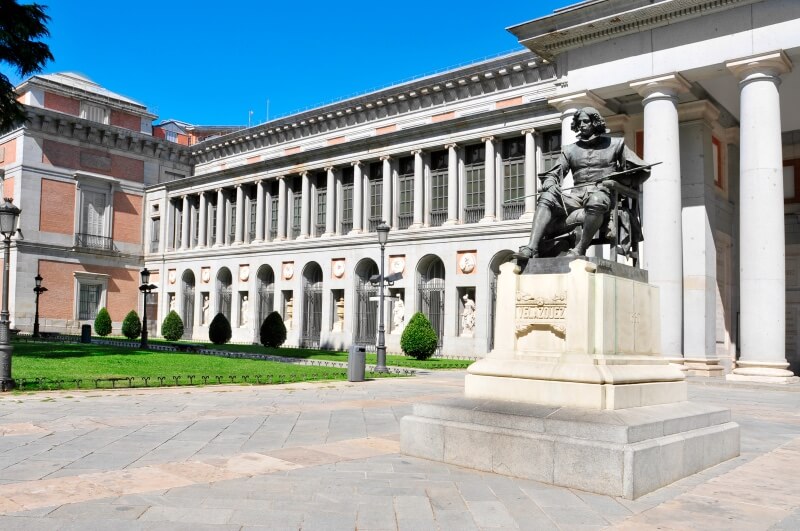
- The Prado is Spain’s national art museum and has the world’s best collection of Spanish art (and one of the best European art collections as well) so if you’re a fan of Goya, Velazquez (Las Meninas is here), or El Greco, this is the museum for you. (You can also download itineraries for 1-, 2- or 3-hour visits.)
- If you’re a lover of contemporary art and the likes of Picasso and Dalí, rush to the Reina Sofía.
- The Thyssen-Bornemisza Museum houses the world’s second-largest private art collection and covers ground the other two don’t – English and Dutch artists, for example, the pre-modern Impressionists and Expressionists, and great European and American 20th-century artists.
- The city of Madrid has an English-language app – Essential Art Walk Guide, which leads you through eight masterpieces in each of the three museums for a total of 24. You can download the app or the guide here.
6. El Retiro
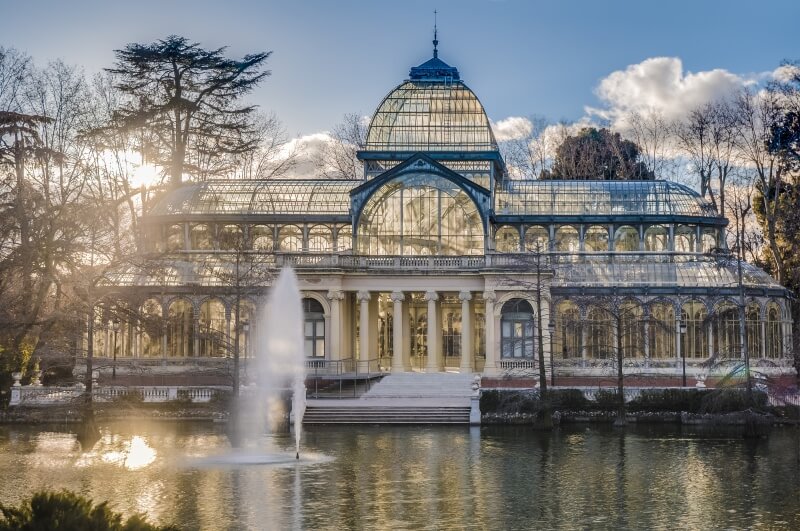
Exhausted by the museum or searching for a bit of shade from the hot city sun? Madrid’s spectacular El Retiro park (its real name is Parque del Buen Retiro but no one calls it that), is in the neighborhood.
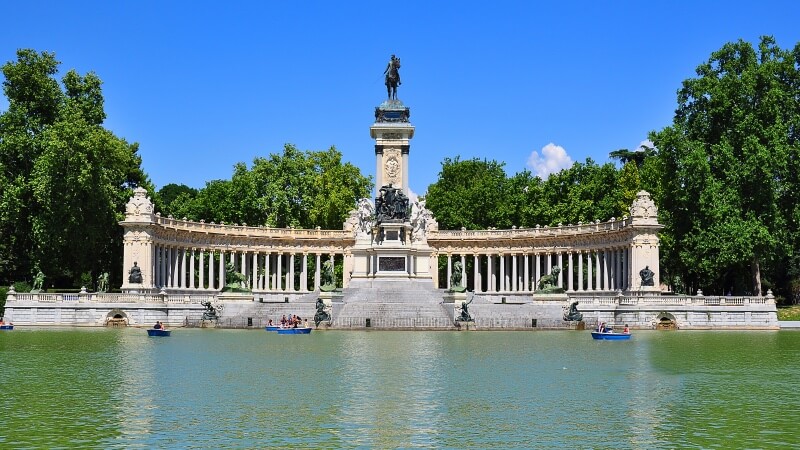
The park’s modest beginnings date back to the early 1500s and over the centuries, bits and pieces were added, including a large pond (more of a lake, actually) French-style gardens, and historical monuments. Exhibitions have been held here and there are summer concerts, street performers, and puppet shows.
Like most large public areas in Spain, exciting things happen. Rent a rowboat and get yourself out on the water for half an hour to calm those frayed city nerves. Or for something different, if you’re comfortable with this, take a Segway tour of the park.
The Paseo del Prado, which adjoins the Retiro, is listed as a UNESCO World Heritage Site… and it’s easy to include if you’re trying to see Madrid in a day.
7. Puerta de Alcalá and Plaza de Cibeles
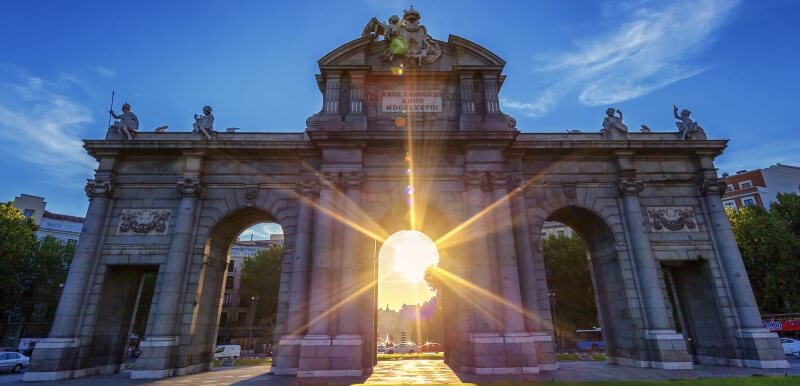
The Puerta de Alcalá is a massive triumphal arch, the kind that looks so good in photographs you can’t resist snapping away. It sits on the northwestern corner of Retiro park so you can exit the park right here if you’ve dropped in for a visit.
The Puerta (or gate) used to be part of Madrid’s original city walls and has quite a rich history – it has been hit by a cannonball, a Spanish prime minister was assassinated here, and it has been used as a migration path for sheep! It’s also a popular venue to broadcast world-class live concerts.
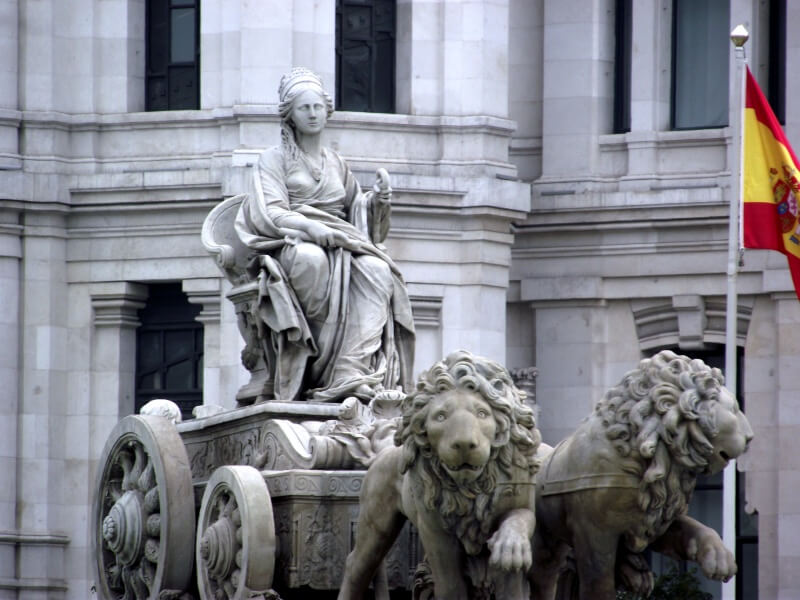
Plaza Cibeles is a busy square (it’s actually round, not square), anchored by an imposing fountain representing the goddess Cybele. The harmony of the buildings that flank it is striking.
If you want a brilliant view of downtown Madrid, go up to the sixth-floor restaurant in the Palacio Cibeles or even better, to the eighth floor where the mirador is located. Be prepared to be stunned. Just stay away if the Real Madrid football club happens to win a game – you might be engulfed by all the fans who celebrate here.
8. La Gran Vía
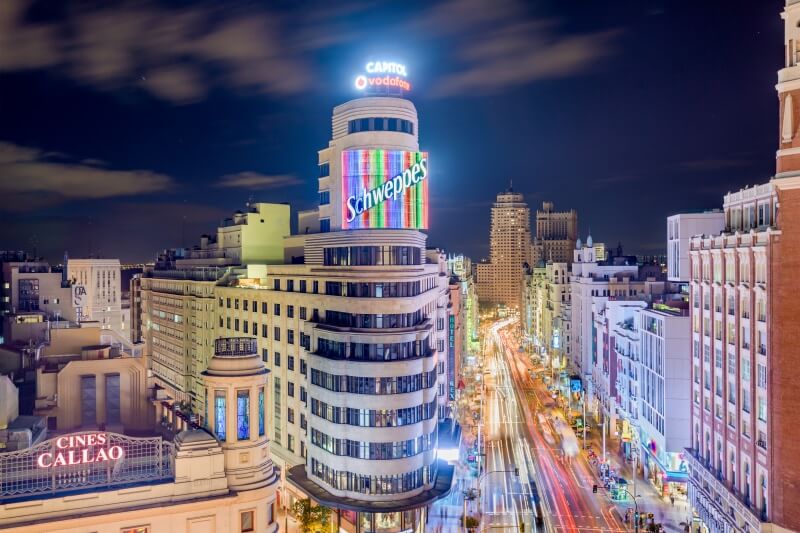
The Gran Via is a Madrid must see. It isn’t a particularly long street and a non-stop walk should take about 20 minutes.
Except that’s not how to walk this street, not at all.
This is a street from which to look UP – it’s an architectural marvel covering pretty much every historical period of this beautiful city. This part of Madrid is guaranteed to be crowded any time of the day or night, except perhaps Sunday mornings. It’s where people walk and shop and eat. It’s the thing the people of Madrid do…
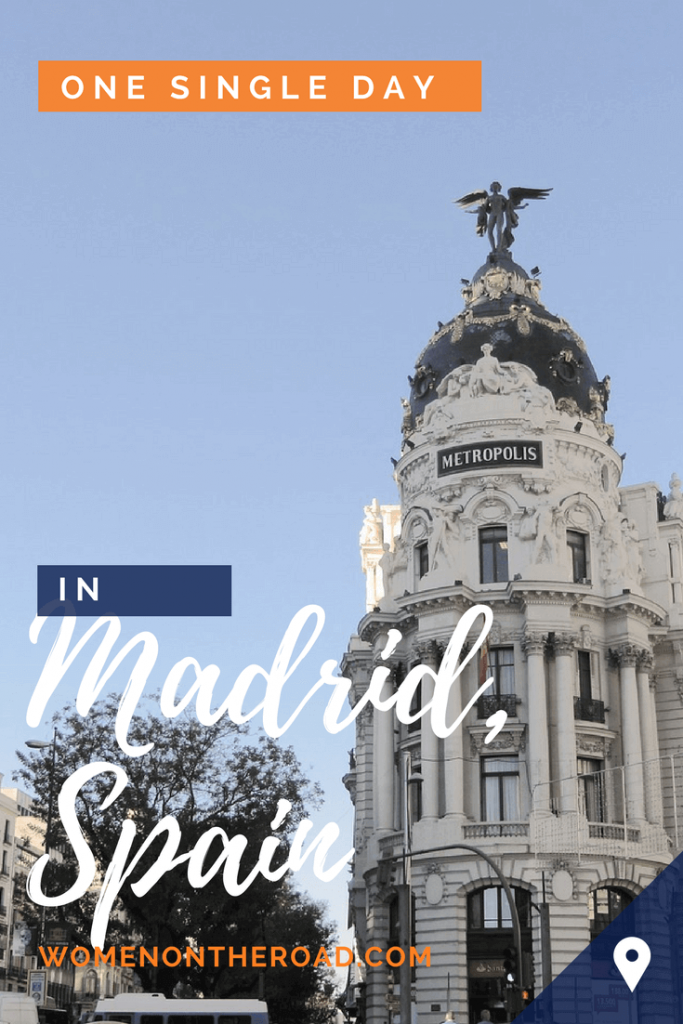
Start walking from the striking Metropolis building, the one with an angel sitting on top of a dome.
Halfway down the Gran Via, get ready for another view, from the 9th floor of the Corte Inglés department store on the Plaza de Callao. If you’re peckish, it’s a good place for a coffee and a nibble. And a quick bit of air-conditioned shopping on a hot day. Keep walking until you reach the Plaza de España at the bottom.
9. Plaza de España
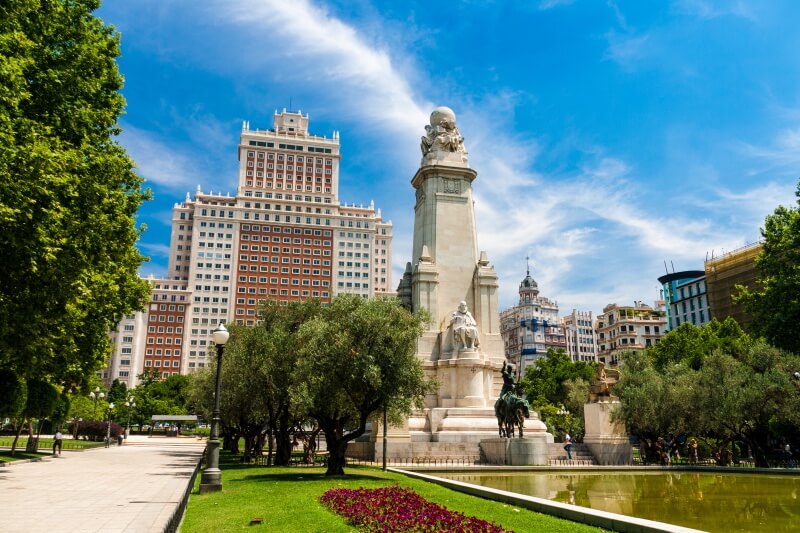
Few cities consider these modest towers to be skyscrapers (there are taller ones but on the outskirts of town). This silhouette of downtown Madrid hasn’t changed in decades.
By now, daylight is probably waning so you should quickly drop by the statue of Cervantes (who wrote Don Quixote) and then hurry on to the Temple of Debod.
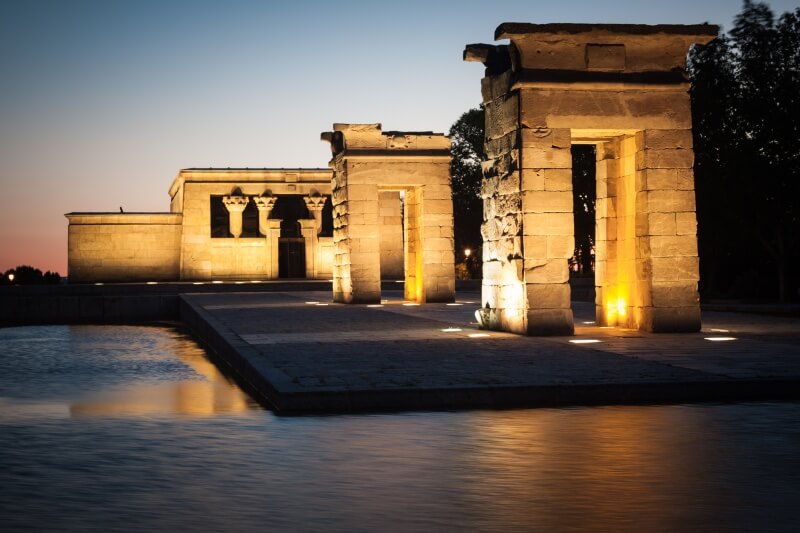
10. Temple of Debod
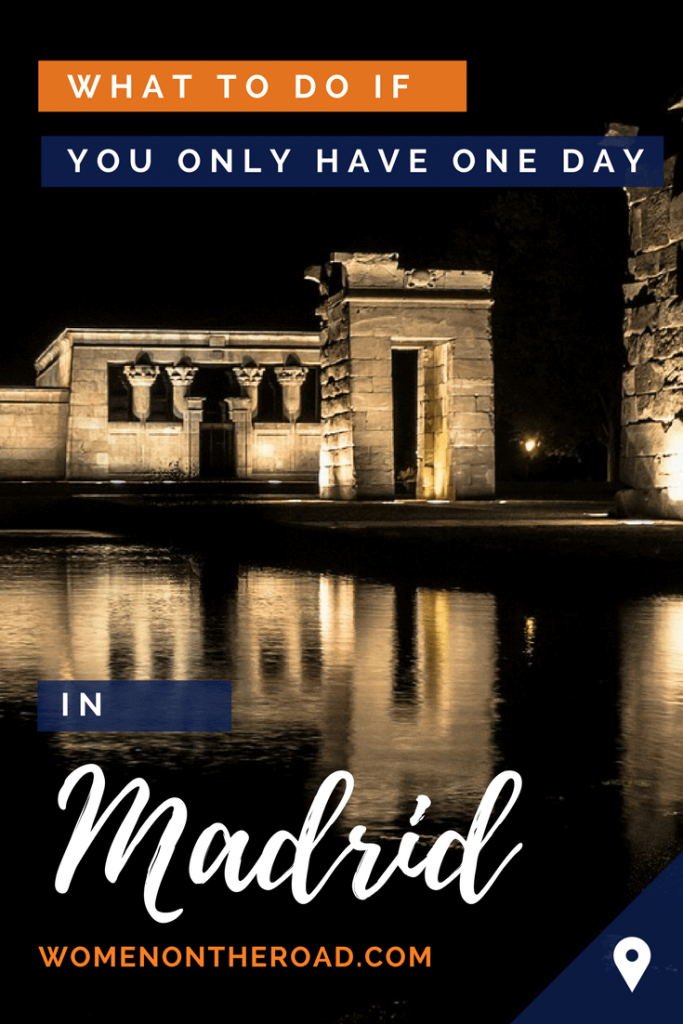
Sunset is the perfect time to catch this beauty. The Temple is an intriguing monument, donated by the Egyptian government and transported stone by stone to thank Spain for helping relocate ancient historical monuments threatened by the building of the Aswan Dam.
The structure dates back to the second century BCE and is one of the few original Egyptian architectural remnants that can be seen outside Egypt (the others are in New York, Leiden, and Turin). It’s free to visit but only a few people are allowed in at a time so you might have to wait – especially during the popular sunset hours. Walk around and admire the gardens while you’re there.
And this, friends, is the end of the one-day itinerary, but not of your fun in Madrid, not by a long shot. At this point, you could pop into a bar for some more tapas, go back to your hotel for a rest, or get ready for your evening food tour.
Things to do in Madrid at night
By now you’ve been eating so many tapas all day that you could almost be Spanish. And strolling around Madrid is also a favorite way Madrileños spend the hours between the end of the work day and the beginning of the evening.
Remember that in this part of the world, dinner might not start until around 10 pm or later so your evenings can be quite long.
Since time immemorial, “see and be seen” has been a Spanish motto and throughout the country, people walk around in the cool evening air, whether around one of the plazas or down the Gran Vía or along one of the many newer pedestrian areas.
If you’ve only got one night in Madrid, the one thing you must do is see a live tablao flamenco, a performance whose soul is as old as the spirits that seem to inhabit this music.
It’s not to everyone’s taste – Portuguese fado suffers the same fate, as does much Arabic music, but if you forget for a moment whether you like it or not and simply allow yourself to be transported by its twangs of pain, you will have lived an experience you’ll long remember. (Jason Webster’s book Duende: A Journey Into the Heart of Flamenco will help you understand and appreciate the genre so much more.)
There are a number of reputable tablaos in Madrid, along with plenty of tourist traps. If you take a tour that combines flamenco with food, you’ll have a guide who can explain all the intricacies, making sure you enjoy and understand what you’re seeing. For those planning just one day in Madrid, it’s a perfect finale.
Madrid city resources and suggestions
- The city of Madrid provides an amazing range of guides, maps, and itineraries that can help you plan your trip – this trip, or future ones (because you’ll be back!)
- If you’re not in the mood for spending a day in Madrid on your feet, consider getting a one-day tourist ticket for access to buses and subways (known here as the Metro)
- Here are a few ideas of what to drink with tapas
- Madrid’s official tourist office
- To get from the airport to your hotel, you can take the airport bus or subway (but you’ll have to lug your suitcase to your hotel), or travel door-to-door in a taxi or a shuttle (both are more or less the same price)
- Don’t know what to buy? Here are some great ideas of what to take home
FAQ: Madrid for a day
Is Madrid expensive to visit?
Madrid is one of the less costly capitals of Western Europe. It’s not as cheap as Eastern Europe but you won’t go broke – food prices are reasonable and you can find cheap accommodation.
What is the best month to visit Madrid, Spain?
The best time to visit Madrid is during the shoulder season, in September-October and in April-May. Winter can be rainy, cold, and gloomy – but hotel prices will be cheaper. Summer is unbearably hot and most Madrileños know enough to leave town.
Is Madrid worth visiting?
It’s one of the most exciting and varied cities in Spain, bursting with history, picturesque neighborhoods, and outstanding food. You can see as much or as little as you like, but YES.
Is Madrid Spain safe for tourists?
Madrid is quite safe for a city its size. Of course, it has its share of pickpockets but even as a solo woman, you’ll be able to walk around at night without much worry. Yes, there have been terrorist attacks in the city but the same can be said of Paris or London…
What is Madrid best known for?
Madrid is known for many things – but possibly its most global claim to fame is the El Prado Museum.