El Camino, or the Way of St. James, is the name of the pilgrimage to Santiago and one of Christianity’s major pilgrimages, with roots in medieval times, when the remains of St. James the Apostle were discovered in an ancient tomb on the northern coast of Spain.
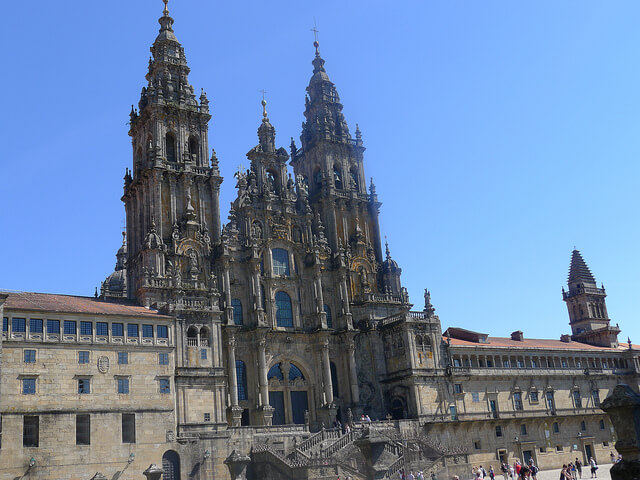
A shrine was built over the tomb and pilgrims began paying their respects over 1000 years ago. That shrine is now the Cathedral of Santiago.
During the Inquisition, ‘deviants’ from the Catholic faith were often punished by being forced to walk El Camino.
Today, while the Camino remains a Catholic pilgrimage, many people travel the road because of its pagan legends. A pilgrimage to Santiago is often a quest, sometimes a religious one, often spiritual, perhaps deeply personal.
The trail’s popularity has also been revived by two modern tales, The Camino by Shirley MacLaine and The Pilgrimage by Paulo Coelho. Both provide vivid descriptions of pilgrimage travel along this route and are extraordinary tales.
The Camino in Winter by Wilna Wilkinson, author of The Way of Stars and Stones
The amazing explorer/mountain climber, Reinhold Messner explains how he managed to climb Mount Everest without any supplemental oxygen: there has to be complete acceptance of whatever will come your way – difficulties, pain, suffering, challenges, demands, physical and mental. Know that you have the resources you need within yourself. Discover those resources within yourself and believe that you will find them. Be ready for an emotional upheaval.
A pilgrimage is in a sense a walking meditation – in this case an 850 kilometre meditation. To be completely alone for that length of time, to have time and space to think, to reflect, to meditate, is very much a luxury in this busy and demanding world we live in.
There are several routes for the pilgrimage to Santiago. The most common, from the French-Spanish border to the city of Santiago de Compostela, is a UNESCO World Heritage Site. Not surprisingly, it’s known as the Camino Francés, or French Way. It is nearly 800km long (500 miles) stretching across northern Spain.
Packing for El Camino de Santiago, according to several friends who have done it, is similar to packing for other hiking trips – only lighter. Remember, you’ll be walking for hours each day, every day, and whatever you take will be on your back all that time. Unlike a traditional backpacking trip, where your backpack tends to sit against a hostel door, this one will sit against you!
Here’s what I would take if I were going for a month in spring or summer – and this is far less than my usual travel packing list, which is more for long-term round-the-world backpacking trips:
- basic clothes: 2 pairs travel underwear, 2 travel bras, 2 tops (1 T-shirt, 1 lightweight blouse, 2 pairs of socks (no blister socks – basically two socks in one), 1 pair travel pants and 1 pair shorts, fleece for cool evenings)
- good hiking boots and a pair of sandals or flip-flops
- sleeping bag, silk sleeping sheet and quick-drying towel – and you might consider a foam pad – it’ll come in handy if all the beds are taken
- rain poncho – and it will rain
- toothbrush and basic toiletries (I always carry baby shampoo – it also works as soap for you and your clothes)
- a very basic first aid kit – my first aid kit checklist may be a little too complete for this trip, but look through it to get ideas of what to take for yourself
- some ‘must takes’ include earplugs, sunscreen, a hat and mosquito repellent
- important papers and money – and please, carry these in a travel money belt or a leg or neck wallet!
- flashlight and Swiss Army knife or Leatherman multi-tool
- a book to read along the way or a loaded Kindle app for your phone
- your map
- cellphone-camera combo
A Lifetime on the Camino – contributed by Anita Grace, Ottawa, ON, Canada
I spent 64 days walking 1,600 kilometres on the Santiago Pilgrimage. However, for all its complexity, richness and challenges, this pilgrimage was experienced as a lifetime.
I was born onto the pilgrimage in Le Puy en Vélay, a small town in southeast France. Without faith or even an understanding of this pilgrimage, I was like a child stumbling my way along winding trails. Slowly, even unwillingly, I begin to understand what it meant to be a pilgrim and to become part of a community. My teachers were priests, hosts, villagers, church custodians and fellow pilgrims. Their lessons were challenging, humbling, yet ultimately enriching.
In this journey of pilgrimage and quest, strangers can soon find themselves deep in conversations about faith and love.
In the baked plains of Spain, under the heat of a relentless sun, I was pushed beyond what I thought was my last source of strength. As I faced new challenges, I felt like I was in middle age, worn by pain and fatigue, yet stronger in my awareness of myself, fortified by friendship and a budding faith.
In the final weeks, a period of old age, I had changed and grown, yet still had some of the most personal challenges to face. I reached Santiago, with the last ounce of strength I possessed, ready to stop, ready for this pilgrim life to end.
Most of those on a pilgrimage to Santiago stay in refuges or ‘refugios’ reserved for them. These are inexpensive, and first-come first-serve. No reservations, and don’t try to ask someone to book a bunk-bed for you. Those who prefer something a bit more upmarket will find B &B and small hotels in most towns along the way.
On average, it takes about a month to walk it. Friends of mine who started in Geneva took two months. Others do it in bits – a week a year, for example. However long you have, will be long enough.
I haven’t walked the Camino yet, but I do occasionally walk short stretches of it – the Geneva-based starting point runs right past my house in rural France and I enjoy following the European gold on blue scallop shell markers along the way.
The Via Francigena to Rome – contributed by Sil (South Africa)
The reanimation of the ancient pilgrimage route between Canterbury and Rome began in the 1990’s after the discovery of a diary written by Archbishop Sigeric who travelled to Rome (ca 990AD) to collect his stole of office – the Pallium – from the Pope. The document, written in Latin, is now in the British Museum.
The 1800km route starts at Canterbury, passes through France, Switzerland and Italy and ends at the Vatican. We (5 friends) started our pilgrimage to Rome on Lake Geneva, crossed the Alps at the Gr St Bernard Pass and walked through the Aosta Valley, Emilia Romagna, Piedmont, Tuscany and Lazio to Rome. Unlike the camino de Santiago, there are few pilgrim refuges along the way and very little way marking. (Ed: that has since changed. See here.)
The average age of the VF five was 55 years. We walked for an average of 25km per day – 27 days and one day off. We walked across two passes, the Grand St Bernard – 2469m and the Cisa Pass -1050m. The longest day was 11.5 hours and the longest distance was 36.3km. We walked through over 210 villages and towns and crossed more than 150 rivers.
The best time to go on a pilgrimage to Santiago? Most pilgrims go in July and August – there’s less rain then but it’s more crowded. If I were walking it all the way I might start in May, when it’s warm enough and more solitary.
Is it safe for women? As safe as safe can be. You’ll sleep in dorms along the way, with dozens of people, and there are security patrols along the Camino. Many women travel El Camino solo. Just use your normal travel common sense.
One drawback used to be returning home from Santiago. Flights were expensive, and trains and buses complicated and uncomfortable. In these days of very cheap international flights, you can fly back from Santiago to London and other European capitals easily and at low cost.
Pilgrims can obtain a credencial from their church before they leave, a bit like a passport. Each time you spend the night in a refuge along the way, get your credencial stamped with a ‘scallop shell’. If you walk the last 100km (or cycle the last 200km) you get a bonus – the ‘Compostela’, a special certificate. But you have to walk that entire final distance in a stretch – no cobbling it together like I do!
And why the scallop shell? There are a variety of answers. Most tend to agree the original scallop shell could be used both as a cup and a plate. The fact that it’s found on the beaches near Santiago proved that a pilgrim returning home with a scallop had actually completed the journey.
If you’re planning on walking the Camino, this might be of interest: